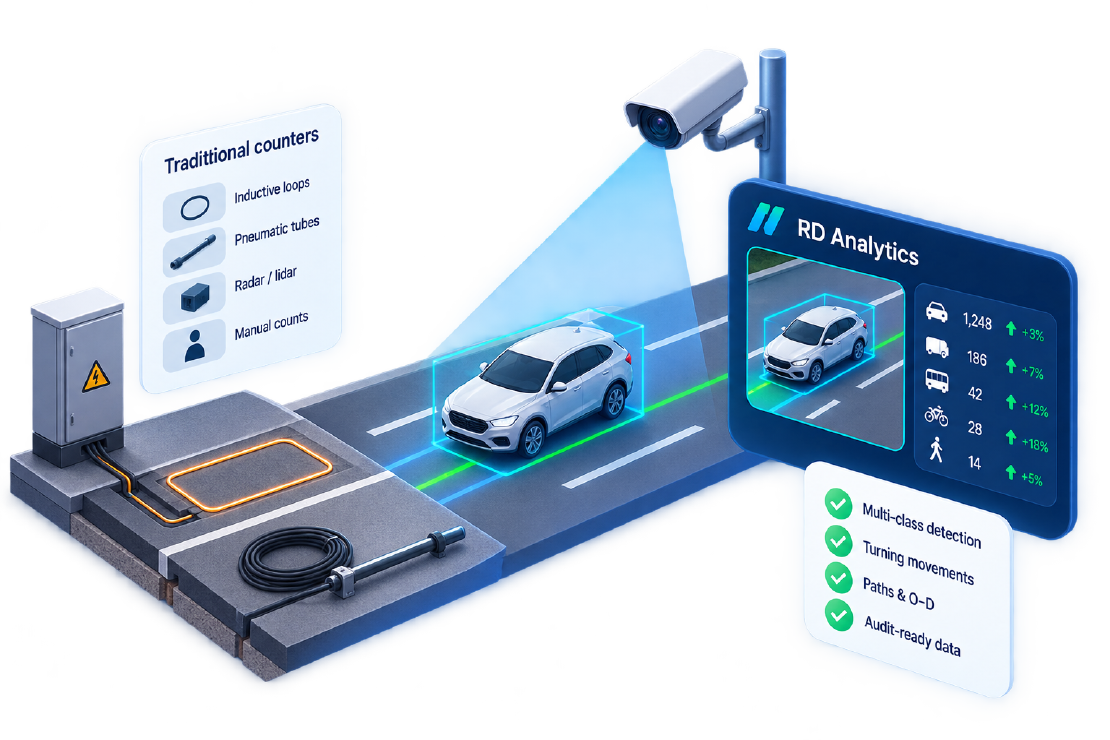
Procurement debates often collapse to a false choice: loops forever, or “AI everywhere.” The useful question is narrower—AI vs loop traffic counter (and tubes, piezos, manual) for this study’s accuracy, coverage, and total cost.
This article compares methods with an engineer’s checklist, then shows where RD Analytics video analytics fits. It complements our earlier piece on manual vs AI surveys by focusing on installed traditional sensors.
What “traditional” usually means
| Technology | Strengths | Weaknesses |
|---|---|---|
| Inductive loops | Mature, continuous volume, weather-robust | Cut pavement; poor multimodal class; fail on maintenance; no paths/O–D |
| Pneumatic tubes | Cheap short studies; speed possible | Lane closure risk; vandalism; limited class; short duration |
| Piezo / WIM | Axle/weight detail for freight | Expensive; specialised install |
| Manual / roadside | Flexible classes on paper | Fatigue; no replay; labour scales with hours |
| Radar / lidar sidefire | Non-intrusive volume/speed | Classification limits; occlusion; capital cost |
Loops remain excellent volume workhorses on instrumented corridors. They are weak when the brief needs pedestrians, fine classes, turning paths, or a site without civil works.
Where video AI wins on accuracy (and where it does not)
Traffic counting accuracy is not a single percentage on a brochure. It is accuracy for a defined metric under defined conditions.
Video AI tends to win when:
- You need class depth beyond loop bins
- You need pedestrians and cyclists in the same dataset
- You need paths / O–D / turning without a second survey
- You need auditability (replay, snapshots, event lists)
- The site has usable cameras already (or temporary poles are cheaper than saw-cutting)
Video AI is challenged when:
- Night lighting is poor and IR is inadequate
- Heavy occlusion (trees, poles, queues masking queues)
- Objects are tiny in frame (wrong height/focal length)
- Contractual axle-class schemes need a view the camera never gets
Industry camera guides from other video-analytics vendors converge on the same rule: if a human cannot clearly see the object, do not expect the model to. Accuracy is mostly capture quality plus QA—not brand slogans.
Loops can outperform video on raw 24/7 volume continuity at a fixed stop-line if they are maintained. Video can outperform loops on everything that is not a simple axle pulse.
Cost: compare programmes, not unit prices
A fair AI vs loop traffic counter cost model includes:
| Cost element | Loops / tubes | Video AI (RD Analytics) |
|---|---|---|
| Install | Civil works, traffic management, reinstate | Mount/aim camera or use existing CCTV |
| Hardware | Loops, cabinet, detector cards | Camera (often existing) + GPU server |
| Labour per study | Low if already installed; high if new cut | Geometry setup + QA; scales with GPU not headcount |
| Extra metrics | Often new sensors | Same footage → class, speed, density, paths |
| Re-use | Fixed location | Move camera or reprocess archive |
| Maintenance | Loop failures common | Disk, GPU, camera cleaning |
Worked intuition for a consultancy (illustrative, not a quote):
- Four-leg TMC, 12 peak hours, manual: 4 counters × 12 h + travel + entry
- Same brief on video: one/two cameras, upload, process, QA hour—especially cheap if CCTV exists
- Annual programme of 40 junctions: loops only help where already buried; video templates compound
Cities that already own CCTV often find video’s incremental cost is software + GPU, while loops’ incremental cost is civil works per site.
Hybrid architectures (the grown-up answer)
High-performing networks mix tools:
- Loops / radar for continuous volume and SCATS/SCOOT-style inputs where already deployed
- Video AI for multimodal surveys, safety diagnostics, O–D, DOOH, and sites without loops
- Manual only for rare edge audits
RD Analytics is designed as the video layer: file/batch surveys today, growth toward stream workflows where licensed, with API output to the same data lake the loop vendor already feeds.
Accuracy assurance checklist for AI counts
- Freeze camera settings for the study window.
- Meet placement/resolution guidelines (camera setup).
- Sample-audit 10–15 busy minutes against manual.
- Document class-group mapping.
- Export event lists for disputed movements.
- State weather/night limitations in the method statement.
That process produces defensible traffic counting accuracy—something a black-box “99%” claim never does alone.
Decision guide
| Brief | Prefer |
|---|---|
| Continuous volume on instrumented approach | Existing loops/radar |
| New site, no civil budget, need classes + peds | Video AI |
| Turning / O–D / before–after | Video AI |
| Axle-true FHWA 13 with side view required | Video + correct aim, or WIM/axle sensors |
| Overnight ATR, dark rural road, no lighting | Loops/tubes (or add lighting for video) |
| Client dispute expected | Video (replay) |
Next step
Run a side-by-side on one approach: loop (or tube) totals vs RD Analytics line counts for the same two hours. The delta—and the extra class/path data video provides—usually settles the AI vs loop traffic counter argument without a philosophy debate.
Explore RD Analytics. Related: ROI, manual vs AI.