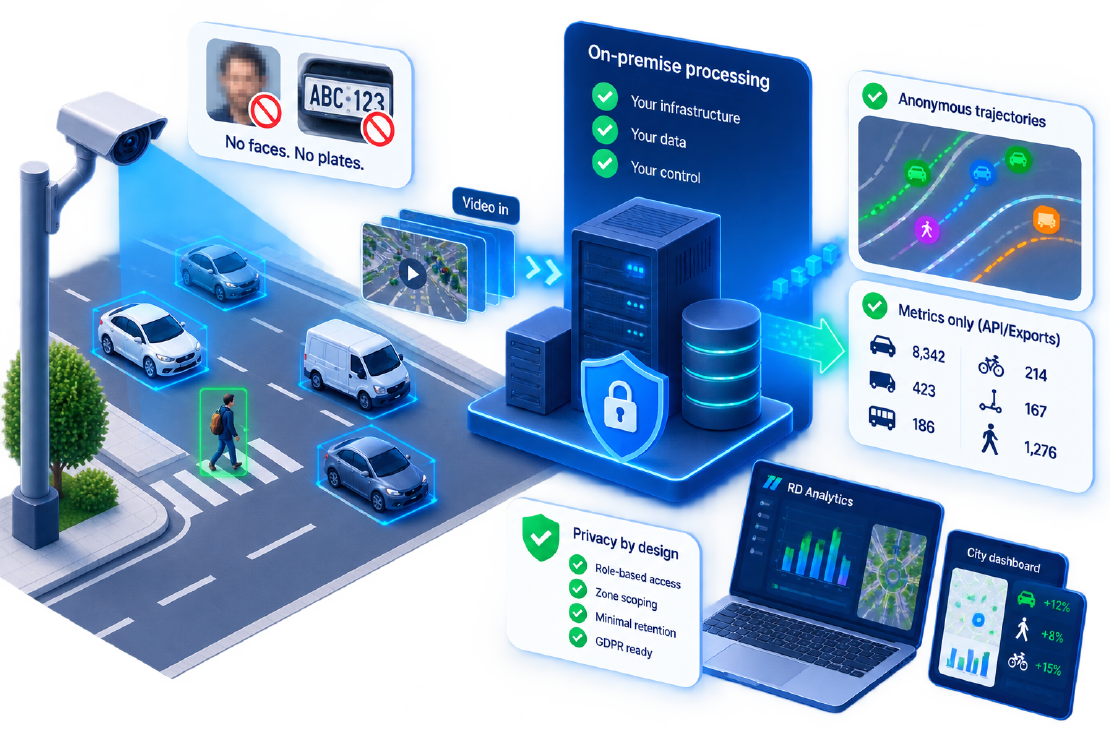
Traffic cameras make people nervous—for good reason. The same pixels that yield turning counts can show faces, plates, and home driveways. Traffic data privacy is therefore not a legal appendix; it is a procurement gate. Cities and consultancies increasingly ask who owns the footage, where recognition runs, and whether video analytics GDPR (and similar regimes) can be satisfied without killing the project.
This article outlines a practical privacy posture for RD Analytics deployments: minimise personal data, process on infrastructure you control, and ship structured metrics—not raw video—into wider systems.
What personal data appears in traffic video
| Content | Risk | Typical need for engineering analytics |
|---|---|---|
| Faces | Biometric / identity | Usually not required for counts |
| Licence plates | Indirect identity | Only for LPR studies; optional in RD |
| House numbers / yards | Contextual identity | Drone and low cameras |
| Trajectories, class, speed | Generally non-identifying if well scoped | Core analytics product |
Other video-analytics vendors often stress anonymous trajectories and customer data ownership. RD Analytics’ differentiator for many agencies is on-premise recognition: video need not leave the municipal or consultancy LAN for core processing.
This article is engineering guidance, not legal advice. Involve your DPO/counsel for DPIAs and contracts.
Privacy-by-design with RD Analytics
1. Keep recognition local
Install on your GPU server (installation guide). RD Analytics does not require a public cloud to detect, track, and count. You retain:
- Raw video on disks you manage
- Tracks and metrics in your database
- User access via roles and zones
That architecture answers the first RFP question: “Where does our video go?”
2. Collect only what the brief needs
| Study type | Prefer |
|---|---|
| Volumes / O–D / speed | Tracks without plates |
| Parking occupancy | Zones + class; short retention |
| LPR / enforcement-adjacent | Explicit legal basis; restrict modules and exports |
| DOOH audience proxies | Aggregates and class mix; avoid plates |
Plate fields on the Data API are opt-in (include_plate). Default integrations should leave them off.
3. Prefer metrics over video in IoT feeds
Smart city buses should carry counts, speeds, and occupancy—not continuous CCTV. Structured exports are orders of magnitude smaller and far easier to justify under data minimisation (IoT integration).
4. Control who sees what
RD Analytics supports role separation (engineers configure scans; viewers browse locations) and zone scoping for API keys. Contractors get the project zone—not the whole city.
5. Define retention up front
Agree:
- How long raw video is kept
- How long snapshots/events remain
- Who may export scene imagery
- Deletion after project close
Automated processing reduces casual human viewing; retention policy reduces residual risk.
GDPR-oriented checklist (EU and similar laws)
Use as a conversation starter with counsel:
- Purpose limitation — engineering/ops analytics stated in notices and contracts
- Lawful basis — public task / legitimate interests assessed; LPR called out separately
- DPIA — for large-scale CCTV analytics or vulnerable sites (schools)
- Processor clauses — if any vendor touches video; prefer on-prem to shrink processor scope
- Storage location — documented (on-prem path vs any cloud manager option)
- Access logs / admin hygiene — named accounts, no shared passwords
- Data subject rights process — even if analytics use aggregated outputs
- Drone flights — extra notice and geographic minimisation
Regimes outside the EU (PDPO in Hong Kong, CCPA-style rules, sector CCTV codes) differ in detail but rhyme: minimise, secure, document, delete.
Anonymisation and “anonymous enough”
Trajectory points, class labels, and section speeds are typically not personal data when they cannot reasonably identify someone. Risks return when you:
- Publish high-resolution snapshots with readable faces/plates
- Join tracks to LPR and customer databases
- Release raw video with a public FOI dump
Mitigations: blur policies for published stills, plate modules off by default, aggregate before open data portals.
Comparing deployment privacy postures
| Pattern | Privacy profile |
|---|---|
| On-prem RD Analytics (Pattern A/B) | Strong control; video local |
| Cloud manager + local workers | UI in cloud; video still local if designed so |
| Pure upload-to-SaaS survey tools | Convenient; requires strong DPA and trust |
Pick topology with privacy as a hard constraint (edge vs cloud), not an afterthought.
What to tell elected officials
Three sentences usually suffice:
- We use cameras we already have (or temporary survey cameras).
- AI extracts traffic statistics on our own servers; we do not sell video.
- Dashboards show counts and speeds—not identity—unless a separately authorised LPR use case exists.
Next step
Before your next survey season, write a one-page traffic video analytics privacy note covering purpose, retention, modules used, and export rules—then configure RD Analytics to match. Contact Road Data Systems if you need an architecture review for GDPR-sensitive deployments.