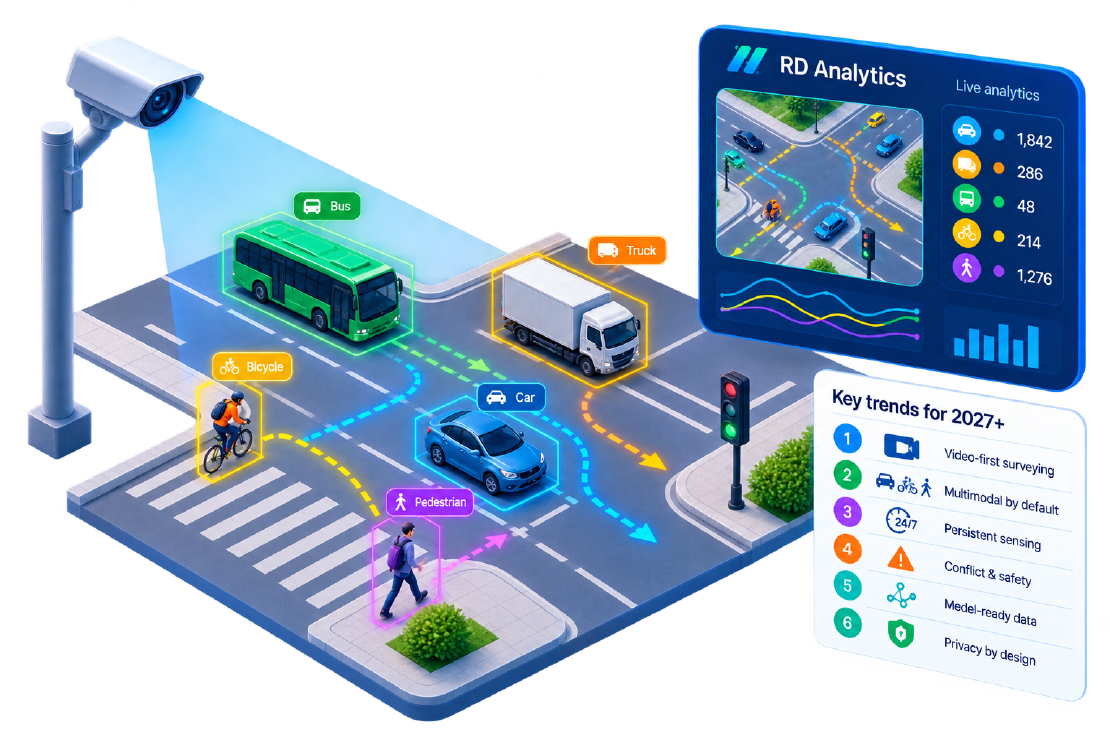
Traffic surveying is mid-shift: from people with boards, to tubes, to AI video as the default evidence layer. Looking toward future traffic analytics 2027 and beyond, the winners will combine multimodal AI, reusable camera estates, and privacy-aware architectures—not bigger clipboards.
Here are the smart city traffic trends we expect to shape Road Data Systems customers—and how RD Analytics is aligned.
Trend 1 — Video becomes the primary survey instrument
Manual counts retreat to audits. Tubes remain for niche ATRs. Video wins whenever classes, paths, or replay matter. Procurement language will say “video-derived TMC/O–D” the way it once said “manual classified count.”
Implication: Invest in camera standards and GPU capacity, not seasonal counter headcount.
Trend 2 — Multimodal is non-negotiable
Vision Zero, micromobility, and complete streets force pedestrians, cycles, and scooters into the same datasets as cars (custom classes). Single-mode loop programmes will look incomplete in funding bids.
Trend 3 — From projects to persistent sensing
Cities keep cameras up; analytics runs continuously or on frequent batches. Survey firms productise subscription monitoring beside one-off studies. Edge processing keeps costs and privacy manageable (edge vs cloud).
Trend 4 — Conflict and safety analytics enter the baseline
Waiting for injury crashes is politically and ethically obsolete. Near-miss / conflict-style analysis (highlighted heavily in industry safety blogs) becomes a normal annex to scheme sign-off—even when metrics differ by vendor.
Implication: Retain trajectories, not only 15-minute bins.
Trend 5 — Model calibration in hours, not weeks
Transport modelling teams pull trajectories, saturation proxies, and O–D cells straight from video (a recurring theme in other vendors’ writing on model calibration). Survey deliverables look more like model-ready datasets than PDFs.
Trend 6 — Privacy regulation shapes architecture
GDPR-class expectations push on-prem and edge analytics. “Upload everything to a foreign SaaS” gets harder for public clients (privacy). Vendors who can run air-gapped or LAN-local win RFPs.
Trend 7 — Cooperative ITS and CV data complement—not replace—video
Connected vehicles and probe data give network speeds. They under-represent pedestrians and non-connected modes. Video remains the ground truth for vulnerable users; CV data fuses in the IoT layer (integration).
Trend 8 — Custom classes and regional schemes via modules
FHWA, COBA, APAC 10-class, scooter classes—one platform, many mappings and custom nets. Off-the-shelf 4-class detectors look dated.
Trend 9 — Drone surveys industrialise—with rules
UAV O–D and roundabout studies are mainstream where airspace allows. Expect tighter privacy geofencing and automated flight-to-report pipelines (drone practices).
Trend 10 — Partnership ecosystems matter more than lone apps
Camera OEMs (technology-partner programmes common in the market), signal vendors, SIs, and cloud hyperscalers form stacks. Analytics firms that integrate cleanly outgrow those that only sell portals (partners).
Predictions for ~2027
| Prediction | Confidence |
|---|---|
| Majority of urban TMCs in high-income cities specified as video-eligible | High |
| On-prem/edge required in a larger share of public RFPs | High |
| Scooters/micromobility as standard class rows in city KPIs | Medium-high |
| Adaptive signals using video occupancy on >10% of smart corridors in early-adopter cities | Medium |
| Generative “auto report narrative” assistants on top of analytics | Medium |
| Full replacement of loops | Low — hybrid persists |
How to prepare this year
- Standardise camera presets for analytics.
- Stand up an RD Analytics lab server; train two engineers.
- Convert one annual manual programme to video.
- Publish a privacy note with retention rules.
- Pilot one API feed into the city data platform.
- Ask vendors about custom classes and on-prem—not only cloud demos.
A modest programme beats a strategy deck: one corridor, one multimodal KPI, one before/after, one integration stub.
What will not change by 2027
- Physics of occlusion and night lighting still limit cameras.
- Finance still wants ROI tables (ROI guide).
- Elected officials still need plain-language privacy answers.
- Hybrid networks (loops + video + probes) still outperform single-sensor ideology.
Trends reshape the default tool—not the need for engineering judgement.
Road Data Systems’ bet
RD Analytics is built for that future: deep-learning recognition from the BitRefine research line, browser workflows, class groups and custom modules, on-prem control, and APIs into smart city stacks—starting from ordinary files and growing to distributed workers.
Next step: Pick one trend above that already hurts your programme, and run a 60-day pilot. Start with RD Analytics.