Buyers evaluating traffic analytics deep learning platforms eventually ask the same question: who is behind the models, and will the science keep moving after the sales demo? Road Data Systems exists to answer that for transportation—and it sits inside a longer research story at BitRefine.
This article introduces the group’s background (from public About pages) and what that research edge means for RD Analytics users.
Who we are
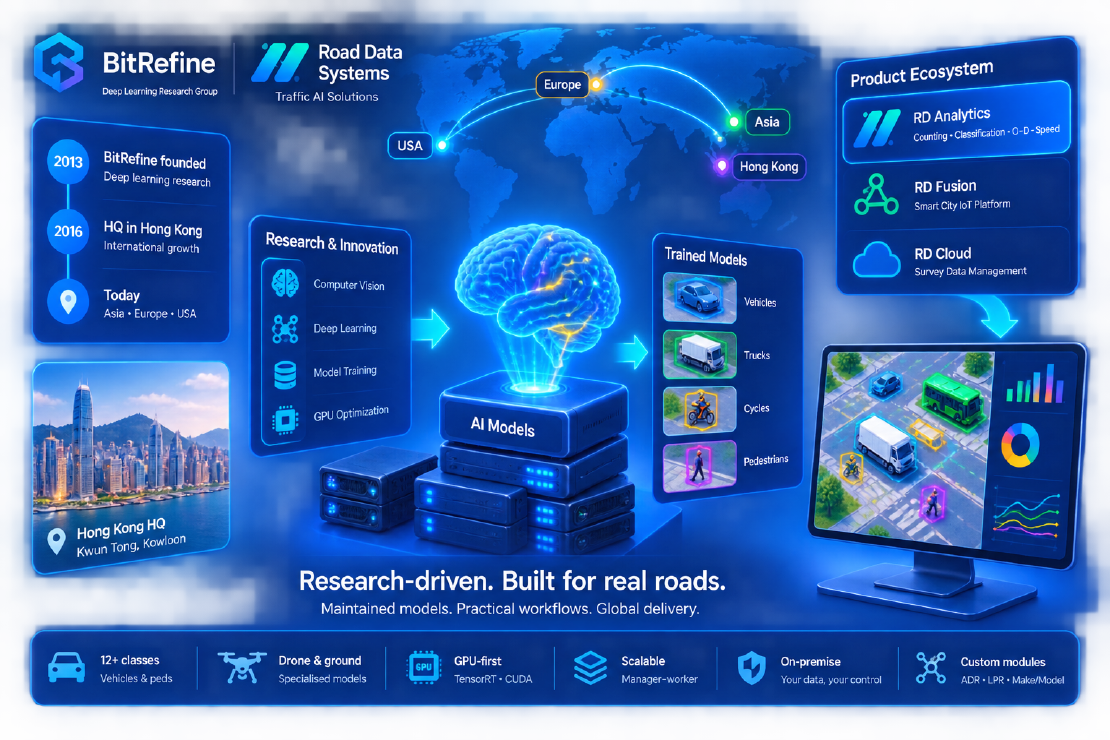
Road Data Systems was founded in Hong Kong as part of the BitRefine group, after researchers and engineers with deep expertise in computer vision and machine learning began building AI recognition for intelligent traffic surveillance. Today RD Systems is focused on transportation industry challenges: comfort and safety for road users, and lower cost for the companies and authorities that run infrastructure.
BitRefine was founded in 2013 as a deep learning research group. In 2016, with a growing international customer base, the company established headquarters in Hong Kong. BitRefine operates across Asia, Europe, and the United States, applying machine learning and computer vision to complex recognition problems—with traffic as a flagship vertical through Road Data Systems.
Contact footprint (Road Data Systems): Kwun Tong, Kowloon, Hong Kong — roaddatasystems.com.
Why a research group matters for traffic software
Deep learning moves quickly. Architectures, training recipes, and deployment stacks (CUDA, TensorRT, transformers vs CNN hybrids) change on a research timescale, not a municipal procurement timescale. BitRefine’s stated posture is continuous experimentation with new algorithms and models so shipped products stay grounded in current computer science—not a frozen 2018 detector with a new UI.
For practitioners, that shows up as:
- Outdoor robustness — real angles, low resolution, difficult lighting called out in product messaging
- Modular neural pipelines — detectors, classifiers, LPR, make/model, custom modules
- GPU-first engineering — production TensorRT paths, concurrent pipelines, edge-to-server scale
- Supervised control — frame-level visibility so engineers can tune, not only trust a black box
BitRefine Heads, the group’s broader video analytics platform, emphasises large neural modules and GPU optimisation for general visual automation; RD Analytics specialises that capability for road traffic counting, classification, O–D, speed, and reporting.
What “research edge” means in the product you run
| Capability | Why research depth matters |
|---|---|
| 12+ vehicle/pedestrian classes | Taxonomy and training data, not a marketing list |
| Drone vs ground detectors | Domain-specific models beat one-size-fits-all |
| Make/model (~3,000) | Large-label classification under messy CCTV |
| Custom modules | Port or train nets for ADR, scooters, niche plant |
| Manager–worker scale | Systems research, not only a single GPU demo |
| On-prem autonomy | Deploy science where data residency demands |
Customers are not buying a paper. They are buying a maintainable recognition stack with a team that still trains and ports models.
Academic and industry collaboration posture
BitRefine-group products are used in commercial and government settings; peer vendors also invest in academy programmes and university trajectory datasets. Road Data Systems welcomes research and consultancy partnerships that need:
- High-volume trajectory extraction for behavioural studies
- Reproducible survey workflows for teaching labs
- Custom class development for regional schemes
If you are a university lab or R&D group, ask about academic licensing and joint model evaluation—thought leadership works both ways.
Global delivery, local control
Hong Kong roots with multi-region BitRefine operations mirror how traffic clients work: global methods, local roads, local privacy rules. RD Analytics’ on-premise and distributed worker options let a European city keep video in-region while still benefiting from models evolved by a research-led vendor.
Product lines around Road Data Systems—RD Analytics for recognition and surveys, RD Fusion for IoT-style city integration, RD Cloud for organising survey artefacts—reflect the same philosophy: deep models where pixels matter, practical workflows where engineers live.
How this differs from pure “camera vendor AI”
Many camera brands ship on-device analytics tuned to their SoC. That is valuable for simple events. Road Data Systems / BitRefine optimise for analytics depth and survey-grade workflows: geometry editors, class groups, merges, report builders, APIs, and custom nets—camera-agnostic inputs, research-grade backends.
A useful evaluation question: can the vendor train or port a network for your odd class next quarter? Research-led groups say yes more often than firmware-only camera AI.
Partnerships with camera and ITS vendors remain welcome (partners article); the core IP sits in recognition and traffic data products.
What customers typically ask on diligence calls
- Training data ethics — outdoor traffic footage under appropriate rights; no surprise scraping of private spaces.
- Update cadence — models and modules versioned with releases; TensorRT engines rebuilt on GPU hosts as needed.
- Explainability — supervised overlays and confidence controls, not only a final CSV.
- Failure mode — documented behaviour under rain, night, and occlusion rather than a single lab percentage.
BitRefine / Road Data Systems conversations tend to be comfortable on those points precisely because research and field deployment share the same organisation.
Talk to the people who train the models
Evaluating traffic analytics deep learning? Ask vendors:
- Who updates the models, and how often?
- Can we add a class that does not exist today?
- Can recognition stay on our GPU hardware?
- Can engineers see and tune detections, or only download a CSV?
Road Data Systems’ answers are shaped by BitRefine’s research identity: continuous model work, custom modules, on-prem deployment, and supervised analytics.
Learn more: About Road Data Systems · RD Analytics · BitRefine